

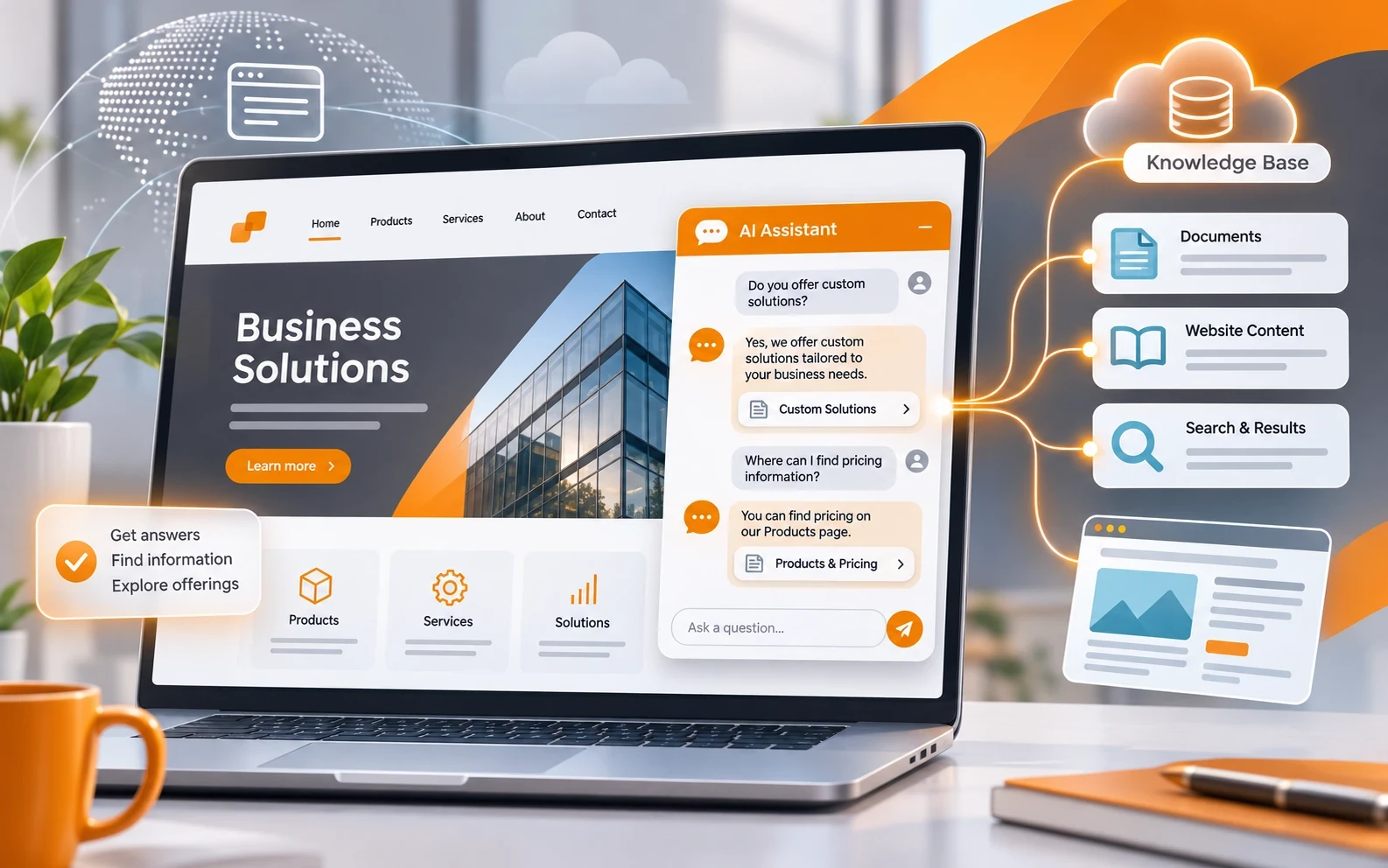
A website may contain detailed information about products, services, and the business, but that does not mean every visitor will easily find the answer they are looking for. Some users want to quickly find out the price of a particular service, others need help choosing a product, and still others have a specific question they cannot find an answer to in the available content.
In situations like these, an AI chatbot can become a useful addition to a business website. Instead of searching through multiple pages or waiting for an email response, visitors can ask a question and get relevant information through a natural conversation.
But can an AI chatbot really improve a business, or is it just another technology trend? The answer depends primarily on how it is implemented, the quality of the available information, and the company’s specific needs.
What is an AI chatbot, and how does it differ from a traditional chatbot?
Traditional chatbots usually operate according to predefined rules and scenarios. They offer visitors certain questions and answers and guide them through predefined steps. This approach can be very effective for simple tasks, but it has limitations when a user asks an unexpected question.
A modern AI chatbot uses artificial intelligence models that can understand different ways of phrasing questions, connect information, and formulate answers in natural language.
For example, a visitor to the website of a company that sells technical equipment might ask:
"Which device would you recommend for fieldwork if measurement accuracy and long battery life are important to me?"
Instead of displaying a generic list of products, a properly configured AI chatbot can analyze available descriptions and technical specifications, ask follow-up questions, and help visitors narrow down their choices.
It is important to understand, however, that an AI chatbot is not infallible. Its ability to provide useful answers depends largely on the quality of the data, its behavior rules, and how it is connected to the website content.
How can an AI chatbot help your business?
1. Answering frequently asked questions without waiting
A large part of communication with customers and potential clients involves questions that come up regularly.
What are your business hours? What services do you offer? How long does production take? What are the ordering terms? Do you ship products internationally?
If answers to these questions are available in a knowledge base, an AI chatbot can provide them at any time, including outside business hours.
This does not mean employees become unnecessary, but rather that they can spend less time answering simple inquiries and more time on tasks that require their expertise.
2. Helping customers choose products and services
Companies with a wide range of offerings often struggle to present all the available options in a simple and understandable way.
Customers may not know the technical names of products or which service is best suited to their problem.
An AI chatbot can help through a conversation in which it gradually gathers information about the user’s needs and directs them to relevant content.
For example, a web design company can use a chatbot to explain to visitors the difference between a simple informational website, a CMS, and an online store, and help them identify a solution that meets their needs.
3. Collecting higher-quality business inquiries
One of the more interesting applications of an AI chatbot is not just answering questions, but turning conversations into concrete business inquiries.
A classic contact form generally collects basic information and a freely written message. As a result, companies often receive inquiries without enough information to prepare a proposal.
An AI chatbot can help users define their needs more precisely through conversation.
For example, before submitting a request to build a website, it can collect information about the type of project, desired features, approximate budget, and timeline.
The collected data can then be transferred to an inquiry form, with the visitor's consent.
The result is a clearer request that makes it easier for employees to prepare a proposal and reduces the need for follow-up questions.
4. Supporting users in different languages
For companies operating in international markets, communicating in multiple languages presents an additional challenge.
An AI chatbot can provide answers in different languages, provided it has access to the appropriate information and the system is configured correctly.
For multilingual websites, it is especially useful to have separate knowledge bases and content tailored to each language. This reduces the risk of information being misinterpreted and enables more consistent communication with visitors from different countries.
Where does an AI chatbot get its information?
One of the most important questions when implementing an AI chatbot concerns the data sources it uses to formulate its answers.
General AI models have extensive knowledge, but they are not necessarily familiar with a particular company's current products, prices, terms of business, and internal procedures.
That is why it is important to connect an AI chatbot to an appropriate knowledge base for business use.
This can include website content, product and service descriptions, technical documentation, frequently asked questions, and additional information that the company wants to make available to users.
When answering, the chatbot can search relevant sources and use the information it finds to formulate a response.
However, connecting to a knowledge base does not in itself guarantee completely accurate answers. The system needs to be configured correctly, tested, and regularly monitored. When it does not have reliable information, it is better for it to say so clearly and direct the user to contact the company directly than to provide an unverified answer.
Can an AI chatbot replace customer support?
An AI chatbot can take over some routine communications, but it is not a universal replacement for employees.
Simple questions about services, opening hours, the ordering process, or product features are often suitable for automation.
On the other hand, complex technical issues, complaints, custom proposals, and situations requiring expert assessment often call for direct communication with a responsible person.
That is why the best approach is a combination of automated and human support. An AI chatbot should make it easier for visitors to make initial contact, provide available information, and identify situations where additional help is needed.
When is investing in an AI chatbot worthwhile?
The introduction of artificial intelligence should not be an end in itself. Like any other business feature, a chatbot makes sense when it solves a specific problem.
Companies that receive a large number of similar inquiries, offer products or services that require further explanation, or want to improve how they collect requests for proposals can benefit the most.
For example, on a website with a large catalog of technical products, a chatbot can make it easier to find information and compare features. For a service company, it can explain the available options to visitors and help them prepare a more specific inquiry.
On the other hand, an AI chatbot may not provide enough value to justify the additional cost for a small website with just a few basic details and very few visitors.
Cost-effectiveness is best assessed based on actual results: the number of useful conversations, questions successfully resolved, the quality of inquiries received, and any reduction in the customer support workload.
At the same time, it is important to consider not only the initial implementation but also the costs of using AI models, maintaining the system, and regularly updating the knowledge base.
What should you consider before introducing an AI chatbot?
Before implementation, it is necessary to define what the chatbot should do, which information it may use, and how it should respond when it cannot provide a reliable answer.
Special attention should be paid to protecting personal data, rules for storing conversations, and controlling access to information.
Users should also be clearly informed that they are talking to artificial intelligence, not a company employee. This approach builds trust and is important for compliance with rules on AI system transparency.
It is equally important to ensure that conversations can be monitored, inaccurate information corrected, and content updated as the company's offering changes.
A quality AI chatbot is not a solution that is set up once and then forgotten. Its effectiveness also depends on continuous improvement.
AI chatbot as part of a business website
At Webmaster.hr, we have developed our own AI chatbot as part of the content management system wCMS, with the aim of connecting information, communicating with visitors, and collecting business inquiries.
Our solution uses selected website content and additional knowledge sources, and can combine natural AI conversations with predefined questions and steps.
This allows the chatbot to help visitors find the information they need, learn about the offering, and prepare a more specific inquiry that is then sent to the company.
Because it is connected to the wCMS system, knowledge sources, conversations, and settings can be managed through the website's administration interface.
Conclusion: useful technology when it has a clear purpose
An AI chatbot can become a valuable addition to a business website, but its value does not come from the use of artificial intelligence alone.
It delivers the greatest benefit when connected to quality information, tailored to visitors' actual needs, and integrated into existing business processes.
For some companies, this means answering frequently asked questions faster; for others, presenting a complex offering more simply; and for others still, generating higher-quality business inquiries.
Instead of asking whether every website should have an AI chatbot, it is more useful to ask: can an AI chatbot solve a specific problem for your visitors or employees?
If the answer is yes, it is worth considering its implementation.
Would you like to find out how an AI chatbot can work on your website? Discover our AI chatbot solution, try the Assistant on Webmaster.hr, or contact us so we can assess the possibilities for applying it in your business together.