


You have a modern website, update its content regularly, and are happy with how it looks. But do you know how well your site is actually optimized for search engines? Can Google and other search engines find and understand its content correctly? Does it load quickly enough on mobile devices? Are there technical issues limiting its visibility without you even knowing it?
An SEO audit of your website provides answers to questions like these, an SEO audit of your website, a detailed analysis of its technical quality, content, structure, and search engine optimization.
Good design does not guarantee good visibility
A website can look excellent and work flawlessly from a visitor’s perspective while having shortcomings that make it harder to rank in search results.
Incorrectly configured indexing tags, duplicate content, insufficiently optimized images, poorly structured headings, or loading issues are just some of the factors that can affect its performance.
Such issues often go unnoticed because they do not necessarily cause visible problems in the day-to-day use of the site. That is why an SEO audit is not intended only for websites that already have problems, but also for those that want to check their technical quality and identify areas for improvement.
What do Google PageSpeed Insights results tell us?
One useful tool for assessing a website’s technical quality is Google PageSpeed Insights. It analyzes performance, accessibility, the use of recommended development practices, and basic technical SEO elements.
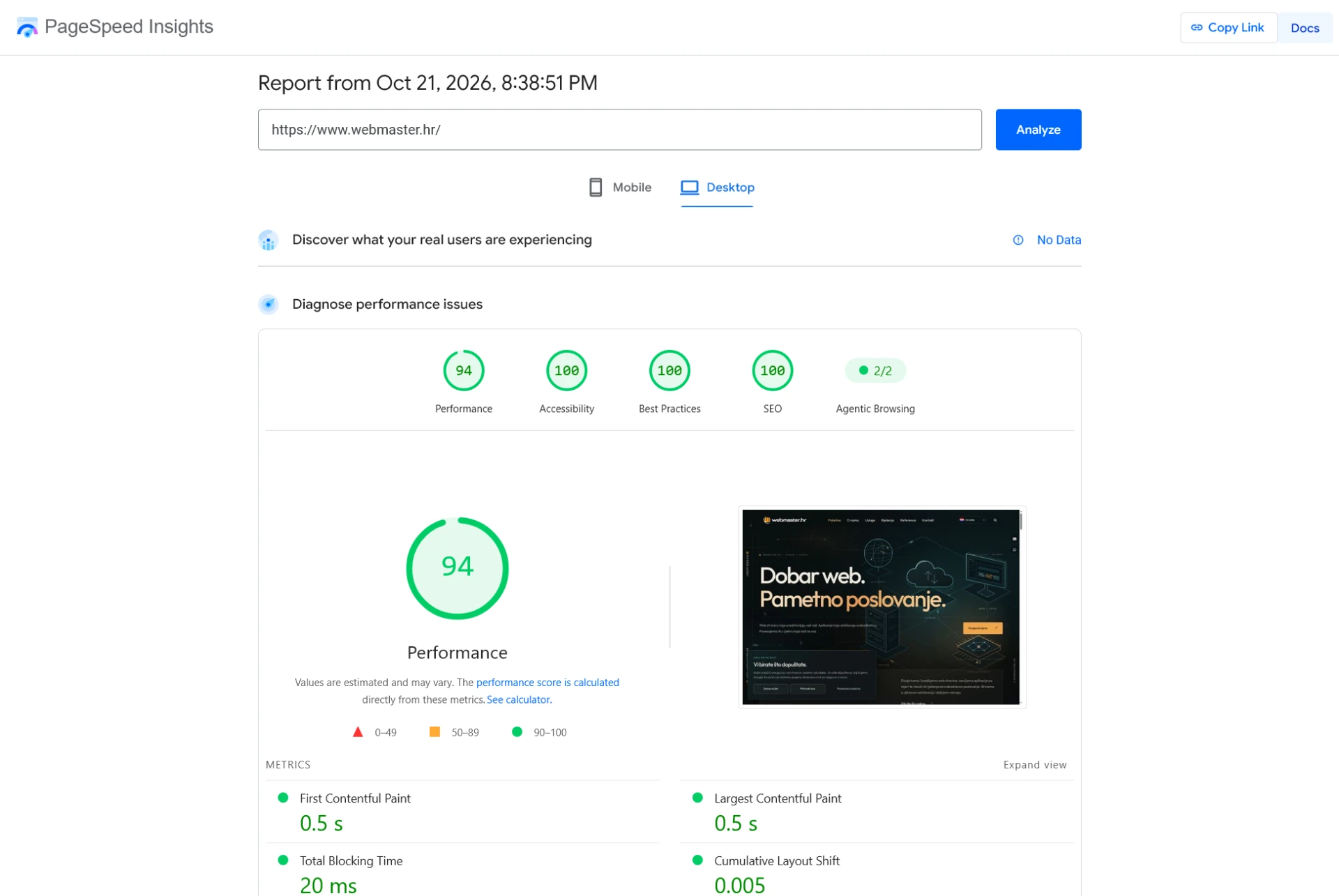
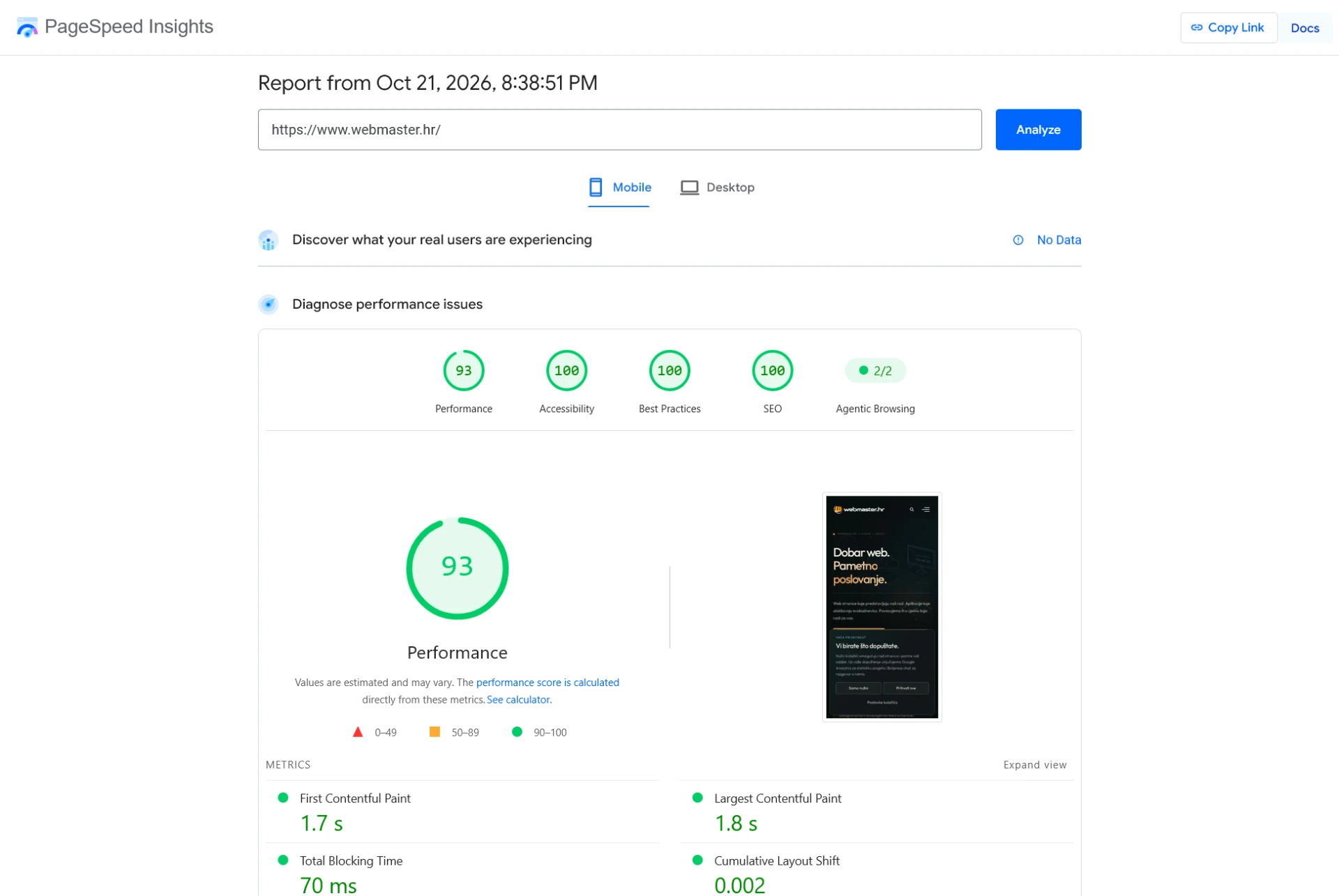
For example, in a test conducted on October 21, 2026, our website Webmaster.hr achieved the following results:
-
Performance: 93/100 on mobile devices and 94/100 on desktop
-
Accessibility: 100/100
-
Best Practices: 100/100
-
SEO: 100/100
These results demonstrate a high level of technical optimization according to the criteria checked by the tool. However, it is important to understand that even a score of 100/100 in the SEO category does not guarantee a high ranking on Google.
PageSpeed Insights analyzes only some of the elements that affect a website’s quality and visibility. A full SEO audit covers a much broader range of checks, including indexing, content, keywords, link structure, and other factors.
What problems can an SEO audit uncover?
An SEO analysis can show that certain pages are not indexed correctly, that important content lacks appropriate titles and descriptions, or that some information is unnecessarily repeated in multiple places.
It can also reveal that a website loads large amounts of JavaScript code unnecessarily, that images are not optimally prepared, or that the server is slowing down content display.
Websites built with modern JavaScript technologies, as well as multilingual websites where incorrect configuration can make it harder to index individual language versions, require special attention.
But the aim of the analysis is not just to compile a list of technical issues. It is equally important to understand which problems have a real impact on the business and which are worth addressing as a priority.
From analysis to concrete improvements
Automated SEO tools can identify a large number of potential issues, but they cannot always explain their actual cause or suggest the best solution for a specific website.
Sometimes it is enough to adjust the content, headings, or internal links. In other cases, it is necessary to intervene in the code, the way content is loaded, the server configuration, or the content management system itself.
At Webmaster.hr, we also approach SEO analysis from the perspective of web application development. More than 15 years of experience building websites and developing our own software solutions enables us not only to identify technical shortcomings, but also to suggest a specific way to resolve them.
This approach is especially useful when the problem cannot be solved by simply changing settings or installing an additional tool.
When is the best time to conduct an SEO audit?
An SEO audit can be useful at any stage in a website's life cycle. It is particularly worth considering if you notice a drop in traffic, lower visibility for your services on Google, or fewer inquiries from potential clients.
It is also advisable to conduct one before a redesign, a change of content management system, or a migration to a new domain. Detecting problems early can prevent a loss of existing visibility and make it easier to develop a new version of the site.
Even if you are satisfied with your current results, periodically checking technical quality can reveal opportunities for further optimization.
Do you know how good your website is?
An SEO audit does not guarantee a top position on Google, and there is no universal solution that works for every website. Its value lies in providing a clearer picture of the current state and enabling informed decisions about further improvements.
If you want to find out whether technical or content shortcomings are limiting your website's potential, you can find more information about our approach, the checks we perform, and examples of results on the page Website SEO Audit.
Sometimes, just a few well-targeted changes can make a significant difference to the quality and effectiveness of your website.